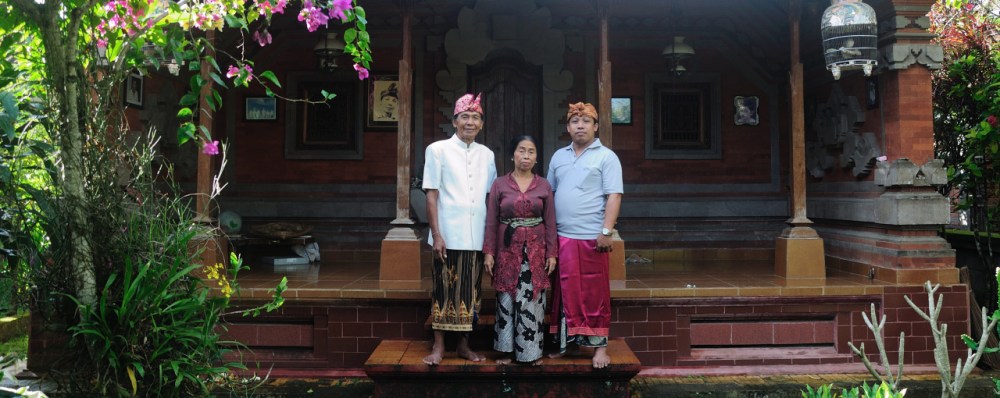
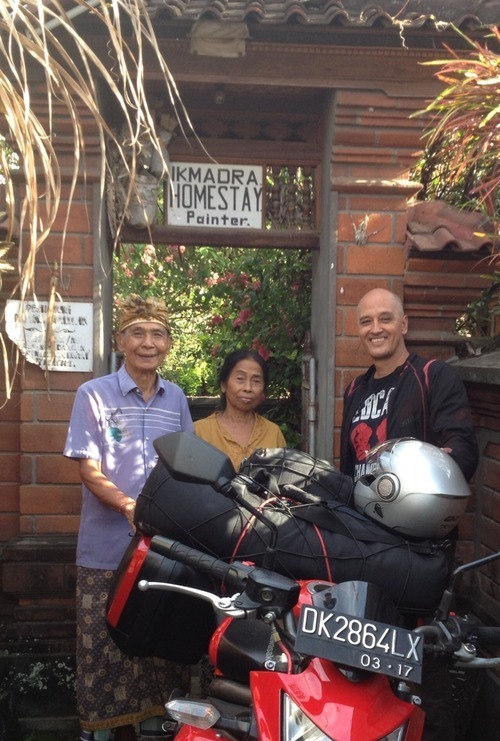
I Ketut Madra, Ni Wayan Konderi and I Made Berata in front of Ketut and Wayan’s house at the Ketut Madra Homestay.
I Ketut Madra, Ni Wayan Konderi and I Made Berata in front of Ketut and Wayan’s house at the Ketut Madra Homestay.
Ketut Madra Homestay, April 2013
… are all in village and family temples within one kilometer of his home.
The best known of these are the temple paintings in three buildings of the Pura Dalem Gde in Peliatan.
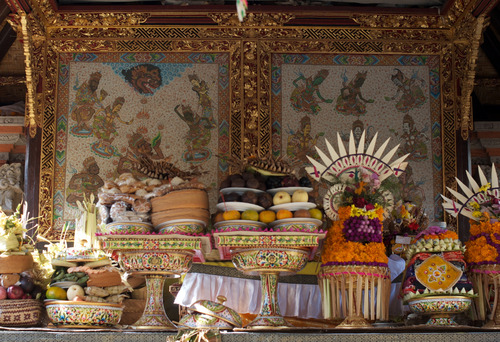
These seven paintings are described in detail on pp. 51-57 of Thomas Cooper’s Sacred Painting in Bali (Orchid Press, Bangkok, 2005).
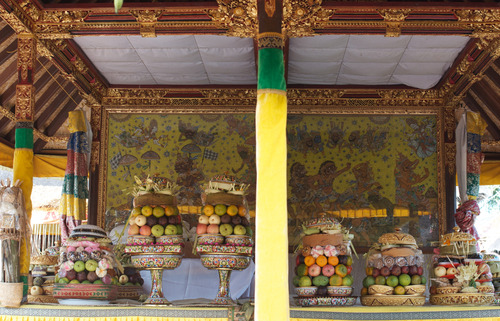
Cooper was able to get much closer to the paintings than Anggara Mahendra and I did during my April visit during the temple’s odalan.
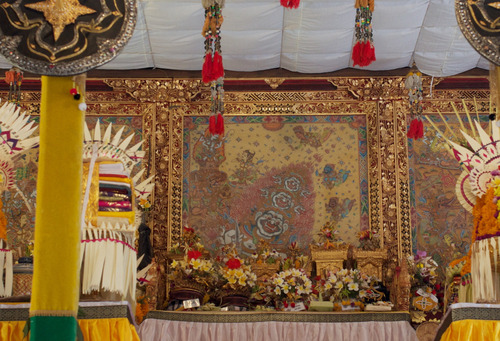
But Anggara captures the celebratory nature of the paintings, which are only visible to the public during these temple festivals. On the first day of the odalan, as the doors that conceal them are opened…,
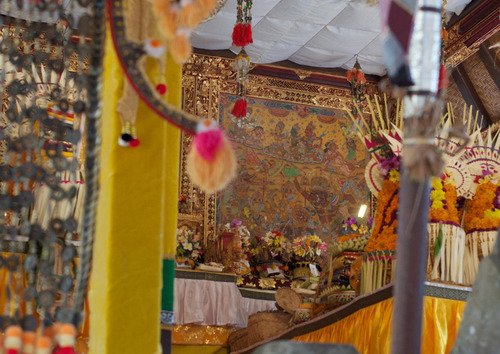
… the intricate offerings to each of the gods associated with these central temple buildings (balé) begin to arrive.
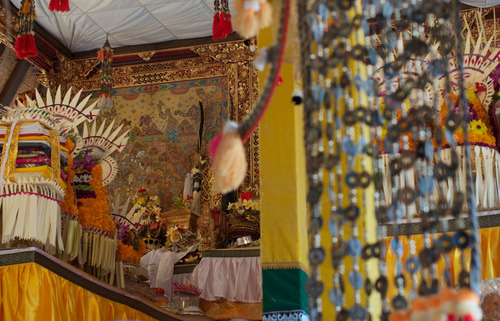
While the offerings complicate the role of the photographer in capturing this key aspect of Madra’s work, they also convey the importance of it to the community in which he lives.
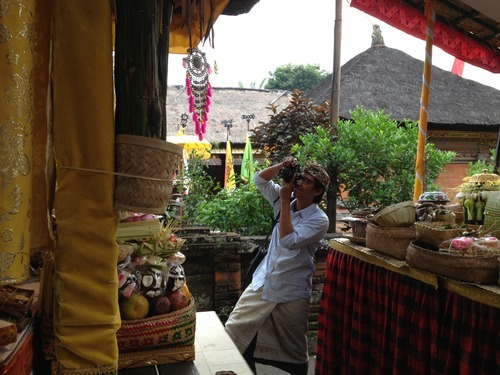
All photos by Anggara Mahendra, except the last one from my iPhone.
By the 1980s, Ketut Madra’s position as an accomplished wayang painter was sufficiently well established that he finally had the time to turn his attention to dance and music.
He learned masked dance – especially the varied roles of bondres and the topeng tua – from Wayan Kantor of Batuan. He was soon performing professionally with Peliatan’s renowned dance group Tirta Sari.
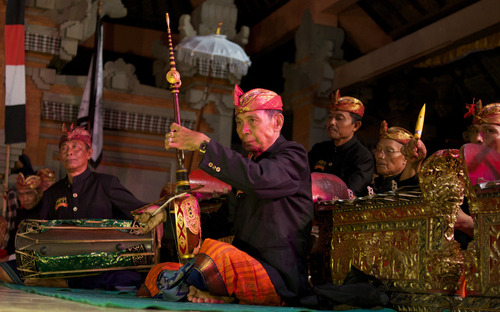
To be a full member of Tirta Sari he needed to be a musician as well. The group’s leader urged him to learn rebab, a two-stringed bowed lute in the gamelan ensemble. A friend gave him a rebab and a cassette tape of solo music; he learned to play by imitating the cassette. On finding he had learned the basics, Tirta Sari’s leader told him to buy a cassette of rebab music as played with a full gamelan – and Madra soon established himself as the group’s “string section.” In the photo below, he plays rebab at the odalan of the Pura Dalem Gde with the seka gong ARMA, 20 minutes after his last performance here.
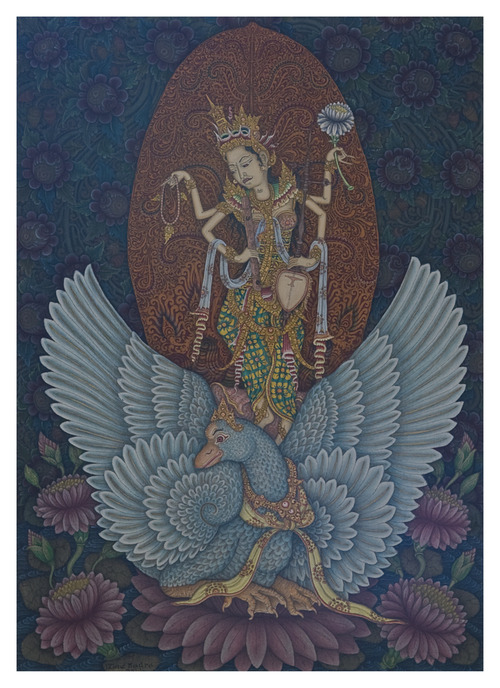
In his art, Madra has often returned to Dewi Saraswati, goddess of culture, music, education, science and more. His two depictions of Saraswati below show her holding two different instruments: in the 1973 drawing she has a simple bamboo flute; in the 2011 painting – and in all of Madra’s recent portraits of her – she carries a rebab.

… in Madra’s studio in Banjar Kalah, Peliatan, before the Ramayana wayang kulit performance there on April 13.

Soemantri (left) is a volunteer curator at Ubud’s Museum Puri Lukisan, which will host the exhibition, Ketut Madra and 100 Years of Wayang Painting from October 7 to November 7, 2013. Madra’s Ramayana painting of the Sacrifice of Dewi Sita (Sita Satya) in the background is a recent work that will be in the exhibition.
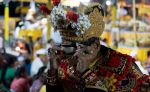

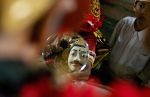
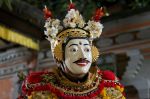
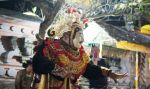
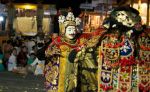
Ketut Madra plays the role of Dalem, the strong, calm, quietly handsome king in the bondres performance at the Pura Dalem Gde in Peliatan. Madra’s old friend and contemporary, Ida Bagus Anom of Mas, carved and painted the dalem mask for him many years ago.
Photos by Anggara Mahendra on April 18, 2013.
I took the photos below at the odalan at the Pura Desa in Pengosekan late in 1973. The 10-year-old baris dancer, the son of Dewa Nyoman Batuan, a painter and community leader, is performing in public for the first time.
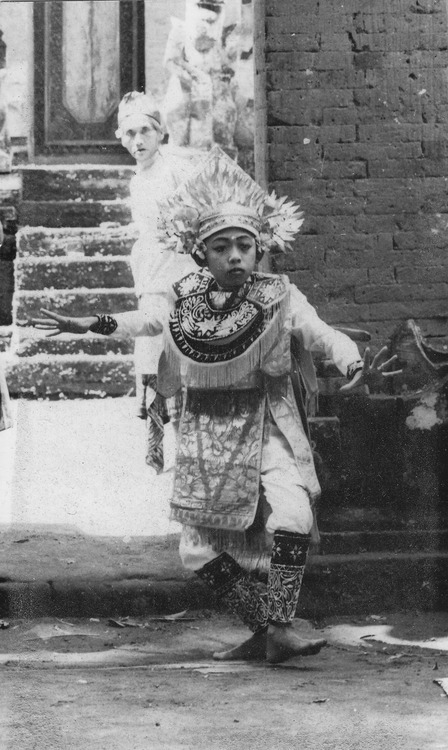
Above, the young dancer has just entered through the temple gate…
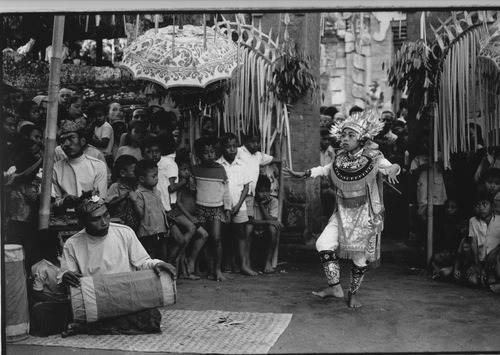
… his friends and schoolmates watch the debut from the best seats in the house…
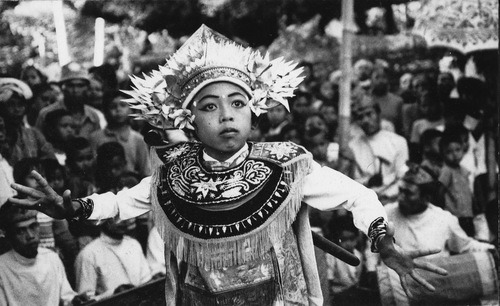
… and he delivers a performance that is still memorable 40 years later.
I gave prints of these photos at the time to his father, and they remain my favorite series of dance pictures from that first year in Bali.
This year, the story leapt forward to the present. Dewa Batuan, the father, died in February 2013 (and is recalled here by Rio Helmi.) The dancer, Dewa Putra Yasa, now 50, learned of the photos from Rio, who’d seen them shortly after I arrived in early April. He stopped in at Ketut Madra’s Homestay to have a look at them on my iPad.
I’d never known who the old man was in the first shot watching the baris dancer enter from inside the gate. It turns out he’s Dewa Putra’s grandfather – and he taught the dance to his grandson.
Dewa Putra Yasa now has the scanned version of these old Agfa black + white prints, shot with my late lamented trusty black Nikkormat 35-mm. SLR.
First preview of an upcoming Ubud Now and Then 40-year retrospective: Rio Helmi (r. with Ketut Madra and Wayan Konderi in April 2013 leaving the Ketut Madra photo shoot, and in October 1973 (l. with Joni Patula.)
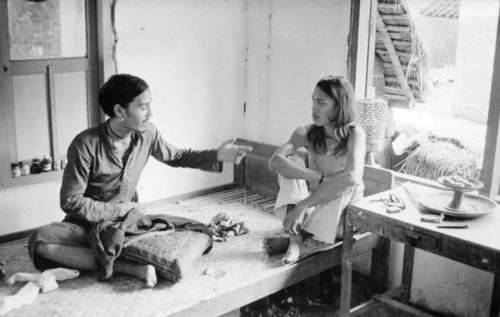
Top photo by me, bottom one by Barbara Miller
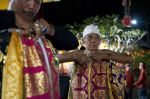

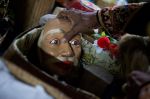
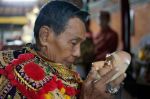
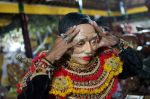
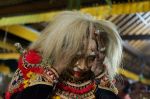
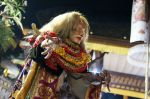
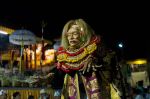
Wayang painter Ketut Madra of Peliatan prepares for a topeng tua performance at the odalan at the Pura Dalem Gde.
Photos by Anggara Mahendra on April 18, 2013.
I arrived in Bali on a working trip just before Kuningan, the end of the Galungan season. I figured with the major holidays over, the next three weeks would be as productive as work time gets in Bali.
That worked, sort of.
I’d forgotten that the season of odalan, three-day local temple festivals, starts in earnest in Peliatan right after Galungan. The most important temple in Madra’s banjar, Pura Dalem Gde di Peliatan, was one of them. The next few posts capture some of the events there.
Here’s the main gate of the inner temple on the third day of the odalan. All the umbul-umbul, triangular temple flags on bamboo poles, were designed and painted by Ketut Madra.
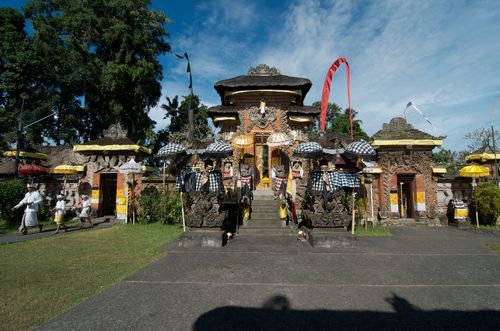
This photo and the one in the earlier Ramayana wayang kulit post are by Anggara Mahendra (there will be a link to his web site when he finishes it!).
 Bali Arts