Author: dmirons
Apple vs HTC
Three takes on Steve Jobs’ decision to sue Android phone-maker HTC for iPhone patent infringements.
Philip Elmer-Dewitt who covers Apple online for Fortune has the story right, I think. His piece links to two others: a short and elegant open letter to Steve from Mac software developer Wil Shipley and a longish post by John Gruber at Daring Fireball that adds thoughtful context to the debate over software as intellectual property.
The big lie about ‘reconciliation’
E. J. Dionne manages to keep the Post’s op-ed page honest.
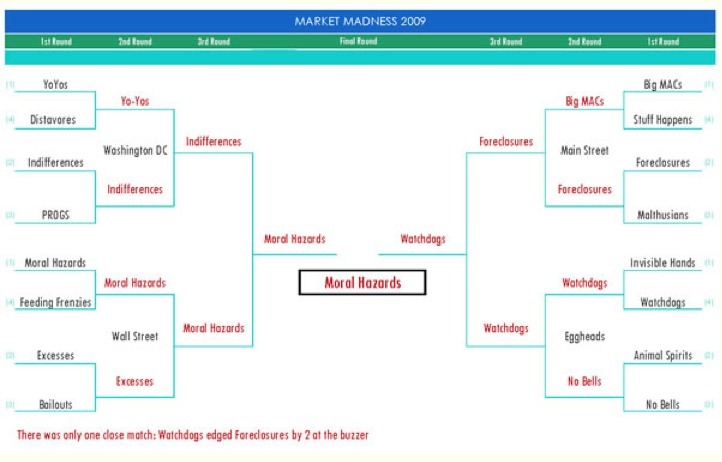
Chart of the Day – David Warsh at Economic Principals borrows a Market Madness chart from the University of Chicago’s Allen Sanderson to show where economists figure the economy went wrong.
Warsh explains:
Adopting as a metaphor the annual NCAA basketball tournament, he came up with sixteen competitive factors judged to have contributed to the global financial crisis and matched them up as in the graphic [above]. A few months later the American Economic Association printed the brackets in the program of its annual meeting and invited members to vote for their regional favorites and for a national champion.
For a description of the various teams, and a sense why voters concluded that the Hazards edged the Watchdogs in the tournament final, click [here]. The game may not yield much real information, but it’s a good exercise, a fine example of economists at play.
“Health Care: Done Deal?”
“I suspect that’s too strong, but it sure looks as if this is really going to happen,” writes Jonathan Bernstein, subbing for the vacationing Sullivan, and citing new reporting from Cohn and Chait at The New Republic. The logical deal seems to be emerging: The House will pass the Senate bill and then send over the “patch” to fix it via reconciliation. I’m not holding my breath, but I’m beginning to believe this landmark legislation is going to pass.
More on the Atlantic web site redesign
Andrew Sullivan thinks it still needs a lot of work and links to colleagues’ comment on the redesign.
More on the politics of health care reform
Two useful articles from The New Republic in my inbox this afternoon on calculating what’s next for HCR: Jonathan Chait’s Reconciliation: Obsessed or Ignorant and Jonathan Cohn’s The Inkblot Test. And the big question, which Cohn doesn’t quite answer: Does Nancy Pelosi have the 217 votes?
Expanding on that Atlantic web site headline just below…
I’ve always been impressed by The Atlantic. Smart writers, an editorial mix full of frequent surprises – over the years, the magazine has always been consistently worth reading.
More recently, Andrew Sullivan’s prodigious blog led me to the online work of Ta-Nehisi Coates and Megan McArdle and back to Jim Fallows, whom I’ve read in print for almost as long as he’s been writing.
I thought The Atlantic’s purchase by David Bradley and its move from Boston to Washington a few years back could signal a decline, that its combination with The National Journal and his other publications might give it a more limited inside-the-beltway perspective. Instead it just keeps getting better.
The Web site redesign’s use of “channels” looks promising, but the truncation of the blogs to two- and three-line snippets, each of which requires further investigation, feels like a mistake. Further poking around reveals that Fallows has similar concerns. Sullivan is the only one who escaped this change. All the other personal pages are now much harder to read through in a consistent way. That’s a loss.
The Atlantic’s web site redesign is impressive.
A good review of a bad book…
… and now I don’t have to read it. Michelle Cottle in The New Republic on GOP Pollster Frank Luntz’s What Americans Really Want…Really
 Bali Arts