While sharing some liberal discomfort over the President’s willingness to accommodate Republican insistence on maintaining the Bush tax cuts for the wealthiest, I’m thinking he really needs to focus on independent voters now and over the next two years. And he did that. After watching yesterday’s press conference, my respect for Obama’s focus on the middle class, the working poor, and the unemployed only grew, as did my appreciation of his vision of the battles to come. I still admire his strategic approach.
Tag: economics
CJR: The Education of Herb And Marion Sandler
Jeff Horwitz, writing in the latest Columbia Journalism Review, examines the way The New York Times and CBS covered the mortgage lending practices of Golden West Financial Corporation in the years just before it was purchased by Wachovia. This is an important story to get right in all the details, in part because Mr. and Mrs. Sandler, who led Golden West for more than 40 years, have a foundation that is the principal financial backer of the investigative journalism web site ProPublica and other liberal causes.
Taking the NYT to task on Social Security
Over at The American Prospect, Dean Baker’s “Beat The Press” column regularly questions the economic assumptions (and knowledge) behind mostly mainstream media reporting. This post on the differences between Social Security and Medicare and Medicaid as a “fast-growing entitlement benefit program” is typical – and classic.
Liars Poker 2
Steven Pearlstein reviews Michael Lewis’s latest, out tomorrow.

The first pararaph: “If you read only one book about the causes of the recent financial crisis, let it be Michael Lewis’s, ‘The Big Short.’”
I will take his advice.
Janet Yellen returning to DC?
My friend and former Haas School of Business colleague Janet Yellen is likely to be the new Fed vice chair. Here she is with her husband (and frequent co-author) George Akerlof on the day he won the Nobel in economics.

Brad DeLong and Paul Krugman are both happy.
Me, too.
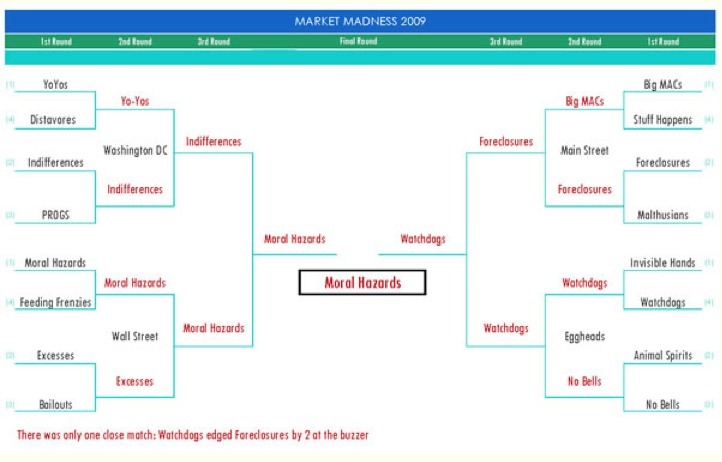
Chart of the Day – David Warsh at Economic Principals borrows a Market Madness chart from the University of Chicago’s Allen Sanderson to show where economists figure the economy went wrong.
Warsh explains:
Adopting as a metaphor the annual NCAA basketball tournament, he came up with sixteen competitive factors judged to have contributed to the global financial crisis and matched them up as in the graphic [above]. A few months later the American Economic Association printed the brackets in the program of its annual meeting and invited members to vote for their regional favorites and for a national champion.
For a description of the various teams, and a sense why voters concluded that the Hazards edged the Watchdogs in the tournament final, click [here]. The game may not yield much real information, but it’s a good exercise, a fine example of economists at play.
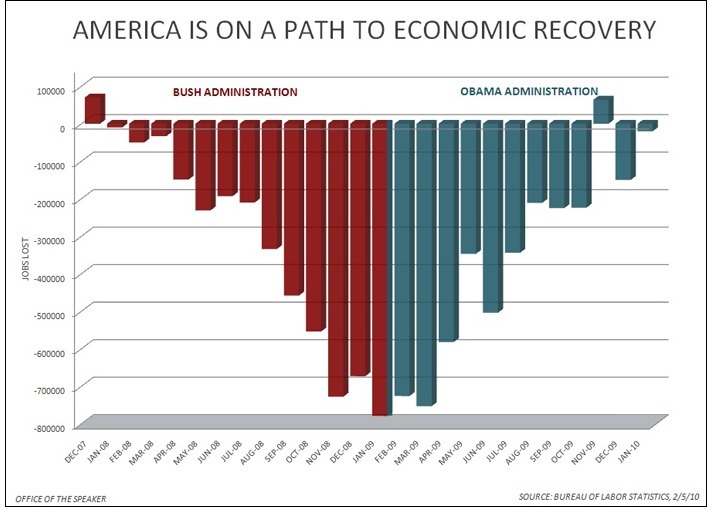
Chart of the Day – The numbers track a negative: The growth and decline in job losses from December 2007 through January 2010. Source: Bureau of Labor Statistics via Speaker Pelosi’s office via TPM
 Bali Arts