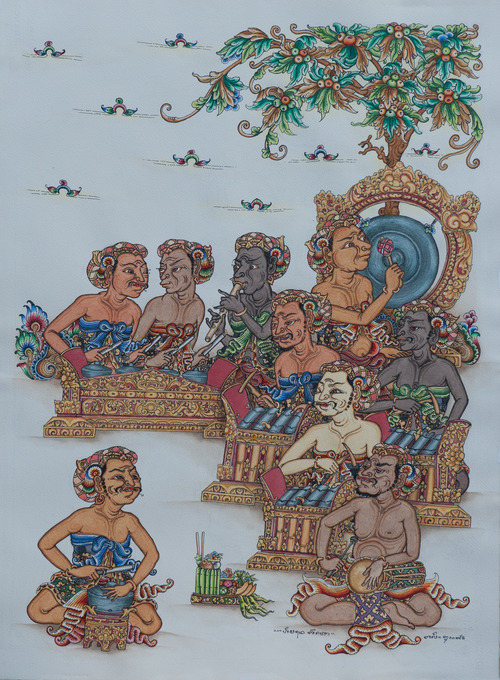
Peliatan artist Madé Berata created this acrylic-on-paper painting for the cover of a new CD of gamelan angklung music from Vital Records appearing later this spring.
At the request of composer-teacher-writer Wayne Vitale, Pak Madé designed this modern wayang work showing angklung musicians and instruments. Its detail recalls old Balinese temple paintings of performances for royal courts and festivals, while the simplicity of the image and the humor of the wayang style caricatures bring it alive as a 21st-century CD illustration.
Vitale recorded the music in Kerobokan in 1992, his first year as director of Gamelan Sekar Jaya of Oakland, California.
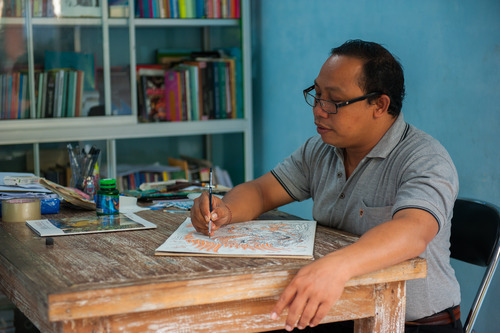
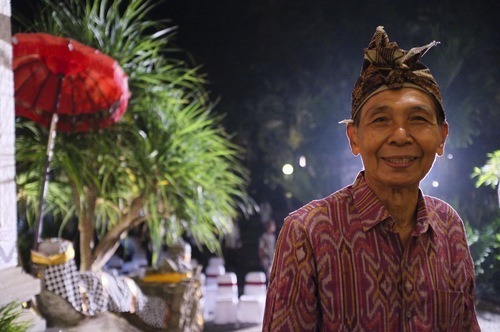
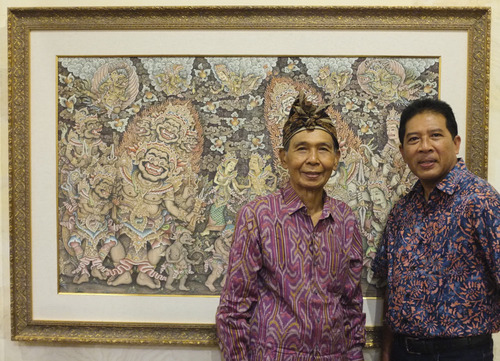
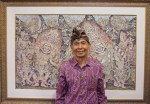
Madé Berata (below) teaches wayang painting at the Institute Seni Indonesia in Denpasar. He is the son of wayang artist Ketut Madra, also of Peliatan.
Ubud’s Museum Puri Lukisan purchased four paintings from its recent exhibition Ketut Madra and 100 Years of Balinese Wayang Painting. Two works by Ketut Madra of Peliatan and two by the late Pan Semari of Kamasan join the museum’s permanent collection for display with other wayang work in Gedung III.
The exhibition and its catalog included 69 Balinese wayang paintings created over the previous century – 40 from my collection, 15 from Ketut Madra’s, and the remaining 14 from seven museums and private collections in the USA and Bali.
Hanoman and Surya by Ketut Madra (above, acrylic on canvas, 54.5 x 44 cm, 1972, #55 in the exhibition catalog) was the catalog cover image and was also used for one of the exhibition posters. One of the most widely reproduced paintings by Madra, it also appears in the September 2013 Departures magazine article Wayang: How to Paint a Legend.
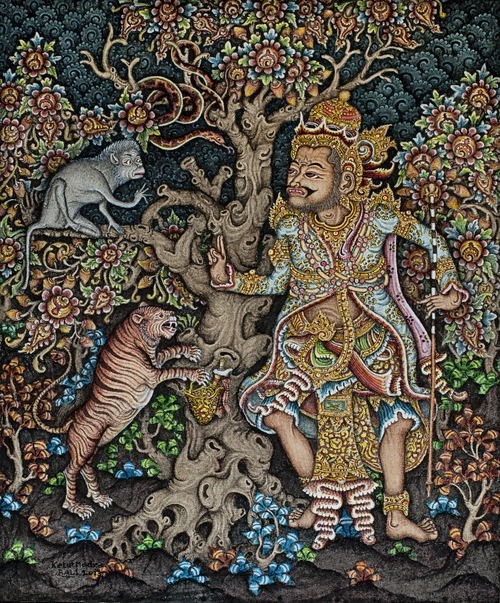
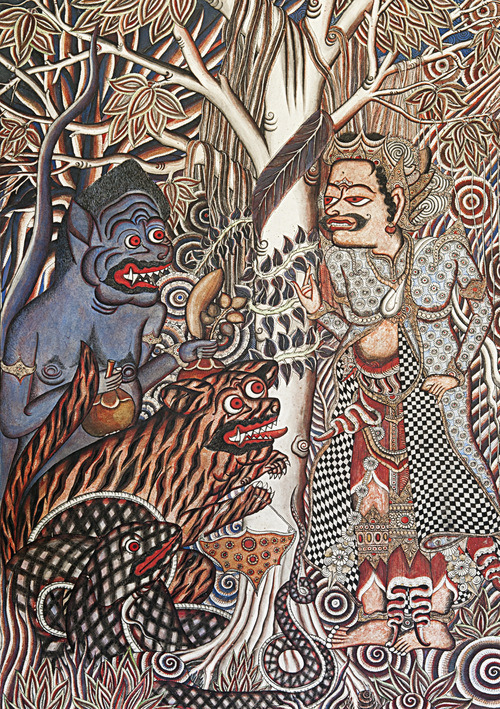
Ketut Madra’s Dharmaswami (above, acrylic on canvas, 60 x 50.5 cm, 2013, #68 in the exhibition catalog) is a recent work completed just before the exhibition. It tells the same Tantri legend as the 1935 work by Ida Bagus Gelgel of Kamasan (below) – one of the best known and most highly regarded paintings in the Museum Puri Lukisan. Madra created the work especially for the exhibition to honor the Gelgel painting.
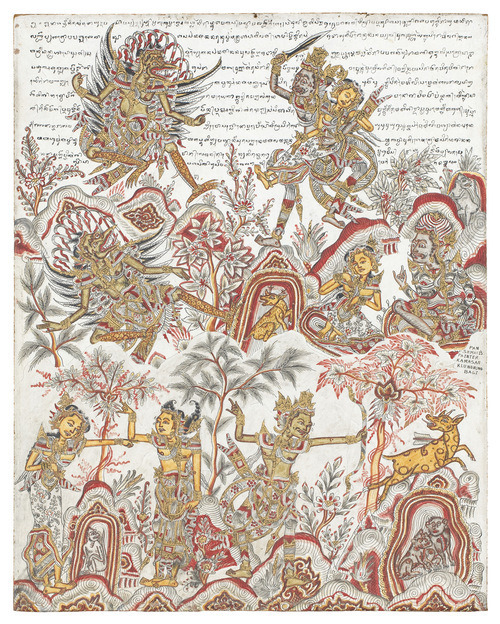
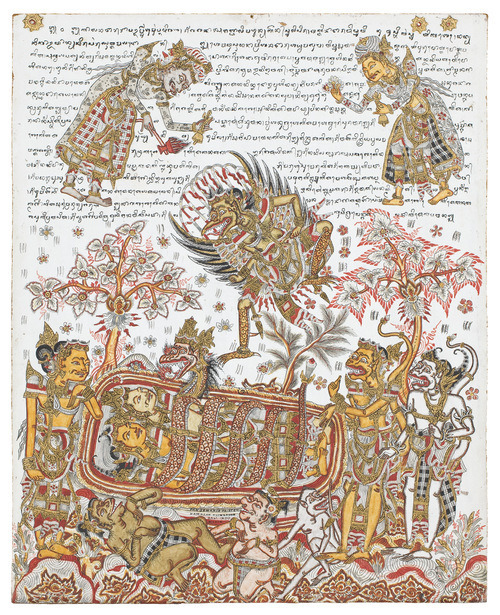
The other two paintings acquired by the museum are the work of Kamasan artist Pan Semari (1922-2000). Both depict Ramayana scenes in natural pigments with gold leaf on hardboard and include the appropriate verses in Balinese script. I bought the paintings from the artist in 1973.
Abduction of Sita, Pan Semari, 58 x 70 cm, 1973, exhibition catalog #29
Rama and Laksmana Released by Garuda from Meganada’s Nagapasa, Pan Semari, 58 x 70 cm, 1973, exhibition catalog #39
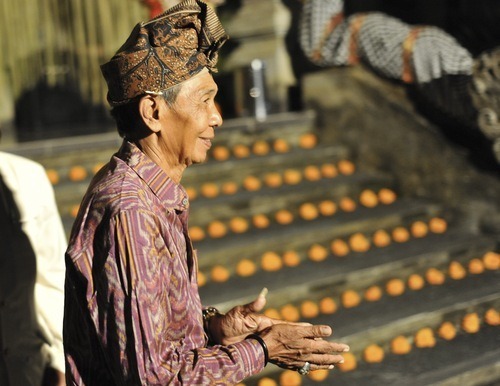
Perhaps my greatest pleasure at the opening of Ketut Madra and 100 Years of Balinese Wayang Painting on October 7 was seeing the joy the event gave this modest 73-year-old artist.
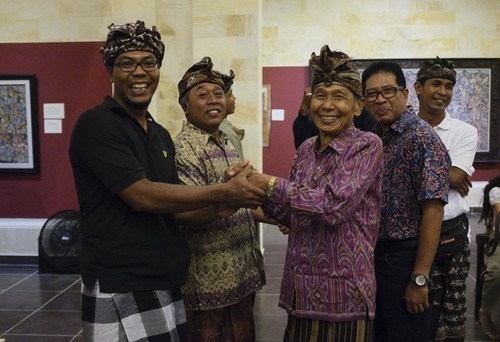
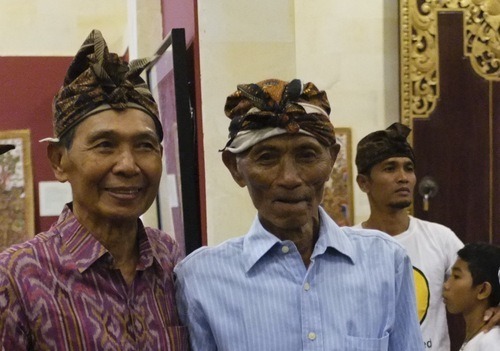
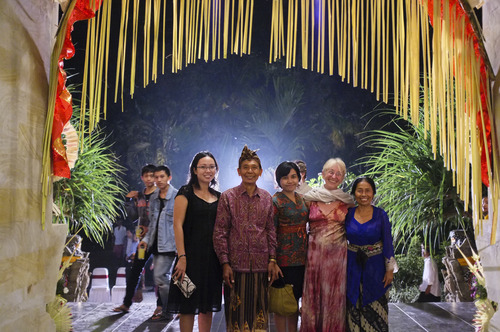
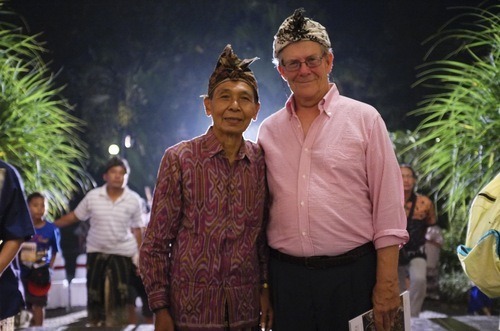
Most of the guests at the opening were Balinese and about half of them were fellow artists who wanted to have their picture taken with Madra.
And Puri Lukisan curator Agung Muning (below right) finally realized the wish of his old friend Rudolf Bonnet to have Madra’s work in the museum’s permanent collection.
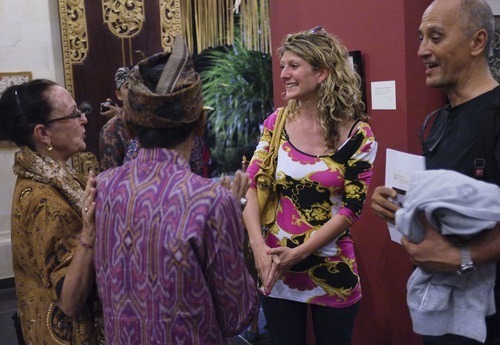
Ketut also reconnected with old friends: Rucina Ballinger (left) and Rio Helmi (right) who’ve known him for almost 40 years introduce him to Catriona Mitchell.
Madra and Ketut Sudarsa with one of their favorite paintings from the Tebesaya Gallery….
Verra Mulianingsih and Luh Windiari, who translated the exhibition catalog into Indonesian, on Ketut’s right and left, with Julie Boak and Ketut’s wife Wayan Konderi on the right…
The village of Kamasan, south of Klungkung in Bali, has been known for centuries as a source of traditional Balinese paintings based on the great Hindu epics the Ramayana and the Mahabharata.
The artists of Banjars Sangging and Siku in Kamasan originally painted for the temples, palaces, and homes of wealthy patrons in Gelgel and Klungkung and nearby regions. While wayang paintings are still created in most regions of Bali, the best work from Kamasan has become known as representing the continuation of the classical tradition of Balinese temple painting.
Kamasan work almost always includes a painted border which makes framing somewhat superfluous. Because Kamasan paintings on cloth often hang in Balinese temples and homes in ways that allow them to move with air currents, museum curators and conservators try to catch that feeling in their best practice of presenting these paintings.
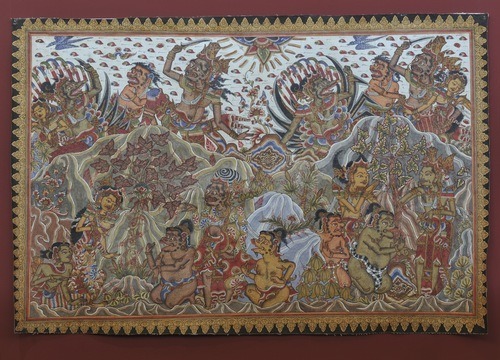
The small Kamasan Ramayana painting above from the recent Museum Puri Lukisan exhibition in Ubud hangs freely on the museum wall. Painted by Made Swacita in 1973, the work depicts the Abduction of Sita in four scenes moving clockwise from the lower right to the upper right. The painting, #28 in the exhibition catalog, measures 87.5 x 58.5 cm.
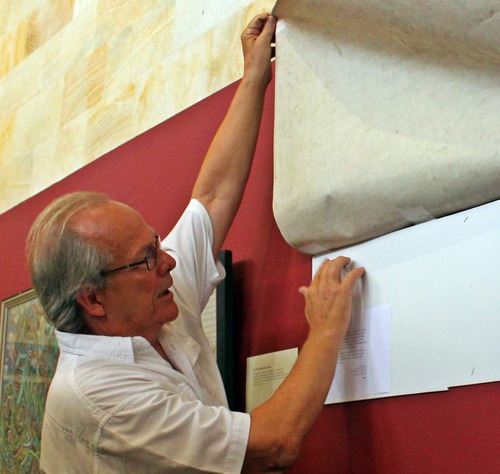
The technique museum curators use to hang this kind of work is quite simple, and can be easily used for hanging these paintings at home. The photo below shows the rice-paper hinges on the back of the work above.
The hinges are attached first to the painting with rice-based glue, acquired in fine powder form and mixed with water to produce a paste of about the same consistency as “Elmer’s Glue” for wood products. When the glue is dry the other half of the hinge is attached to the backing.
Because Kamasan works are almost always painted on cotton cloth sized with rice paste and then polished, the ingredients in the hinge and glue are chemically identical to the cloth to which they are attached.
The backing for any long-term display can be either acid-free white cardboard, which is usually used in climate-controlled conditions in the USA and Europe, or polymeric corrugated board. In tropical conditions, the polymeric board is preferred as some insects find the cardboard delicious. This is what we used (above) at the Puri Lukisan exhibition, following advice of conservators at the National Archives of Singapore.
The bottom edge of any backing behind the painting can be several centimeters shorter than the top edge so it less visible to the viewer. The backing may be attached directly to the wall with stainless steel staples or small stainless nails.
This mounting procedure allows the paintings to “breathe” and to move in air currents and best replicates their appearance in a Balinese environment.
Agung Muning, curator and institutional memory of MuseumPuriLukisan.com Ubud
Twalen and Siwa, by Ketut Madra, 1972
Hanoman in Langka, by Ketut Madra, 1973
Twalen and Tintiya (right) and Merdah and Mahadewa, by Ketut Madra, 2011
Delem and Brahma (left) with Sangut and Wisnu
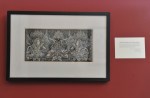
Museum Puri Lukisan, central gallery, building 4.
Museum Puri Lukisan, south gallery corner, building 4
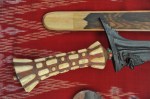
Six of the 12 kris in the exhibition
Kris with naga Bali in the blade
Walmiki Teaching the Ramayana to Rama and Sita’s twin sons, Kusa and Lawa, by Ketut Madra, 1973
At top left, Agung Muning, curator at the Museum Puri Lukisan where he has worked for the past 59 years, plus a few installation shots of the exhibition “Ketut Madra and 100 Years of Balinese Wayang Painting” at the Musuem Puri Lukisan in Ubud, 7 October to 10 November, 2013. Photos by Anggara Mahendra.
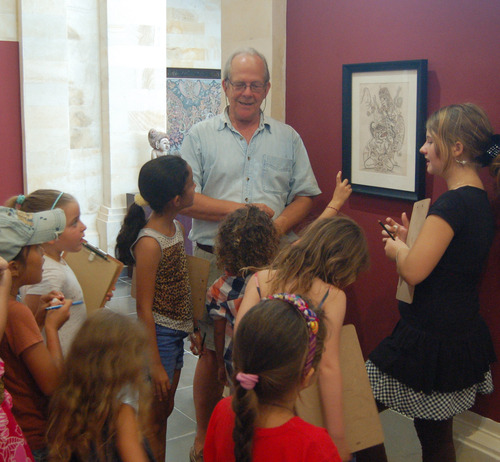
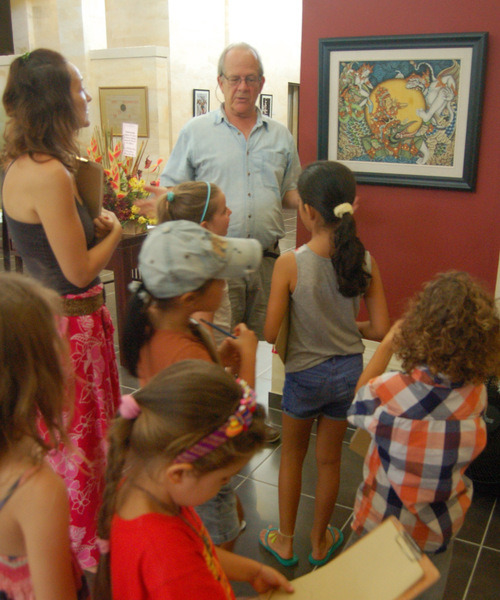
Ten children from Yellow Coco, the art workshop in Nyuhkuning, showed up for a Galungan gallery talk on Balinese wayang painting as children’s stories.
Yellow Coco, which brings Balinese and expat children living near Ubud together for out-of-school lessons in art, music, dance and creative expression is led by Susan Allen (below, left) and her husband Susiawan.
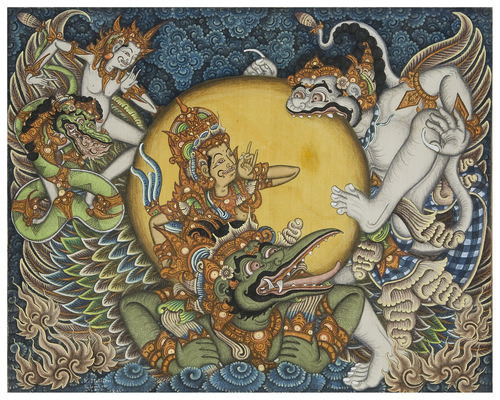
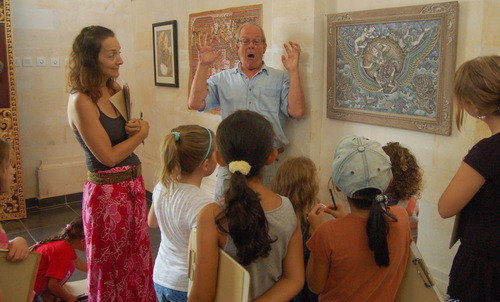
Susiawan caught me in the photo below expressing the surprise felt by Surya, god of the sun, and Aruna, the grat bird who carries him across the sky, when the young Hanoman, mistook the rising sun for a ripe red fruit.
The painting of Hanoman and Surya above is by Gusti Ketut Kobot (1917-1999) of Pengosekan. Peliatan painter Ketut Madra’s version of the same story appears below. Kobot’s work shows the astonishment of Surya and Aruna in the moment. Madra’s captures the same scene a few seconds later after Surya and Aruna realize that their “attacker” is the already powerful and impetuous young Hanoman. (A detailed photo of the Madra version of the story appears in the invitation to the opening, three posts below this one).
The exhibition opening at the Museum Puri Lukisan is one week from tomorrow – October 7 at 6:00 PM. If you’re in Bali and you’re reading this, please do come.












 Bali Arts