The American Journalism Review examines James O’Shea’s startup, the Chicago News Cooperative.
Category: Uncategorized
The Curated Web
Marisa Meltzer, in the latest issue of The American Prospect, analyzes Tumblr as a significant Web trend.
Google Translates
Google’s translating skill leads the New York Times technology section today. The essence of a remarkable article by Miguel Helft:
Creating a translation machine has long been seen as one of the toughest challenges in artificial intelligence. For decades, computer scientists tried using a rules-based approach — teaching the computer the linguistic rules of two languages and giving it the necessary dictionaries.
But in the mid-1990s, researchers began favoring a so-called statistical approach. They found that if they fed the computer thousands or millions of passages and their human-generated translations, it could learn to make accurate guesses about how to translate new texts.
It turns out that this technique, which requires huge amounts of data and lots of computing horsepower, is right up Google’s alley.
Over on the Times’ Bits Blog, Helft interviews a Maori scholar who believes the technology may help to save his and other dying languages.
Google Translate is now working in 52 languages, and “the company recently released the toolkit in 345 languages, from Abkhazian to Zulu,” Helft writes.
I pasted a favorite Russian poem, “Parus” by Mikhail Lermontov, in the translator and got a B-/C+ literal translation with no soul.
To my surprise, below the translation, appears a request: “Contribute a better translation." And so I did. Not something I was planning to do when I picked up my Times this morning.
Who is Mir Hossein Mousavi?
Stanford’s Abbas Milani’s article in The New Republic, The Mousavi Mission: Iran finds it Nelson Mandela, answers the question and explains more about contemporary Iranian politics than any piece I’ve seen in the past 10 months.
NPR Amps Up
CJR profiles Vivian Schiller and the changes in tone and substance she has brought to NPR after her first year as president. Jill Drew reports in depth how NPR is emerging from financial troubles and dealing with all the challenges of new media, competition and collaboration with its affiliate stations and PRI, and finding new resources to cover its declining deficits and ambitious plans.
RealClearPolitics carefully counts House Democratic votes on health care.
Penguin Books Rocks The iPad
Apple vs HTC
Three takes on Steve Jobs’ decision to sue Android phone-maker HTC for iPhone patent infringements.
Philip Elmer-Dewitt who covers Apple online for Fortune has the story right, I think. His piece links to two others: a short and elegant open letter to Steve from Mac software developer Wil Shipley and a longish post by John Gruber at Daring Fireball that adds thoughtful context to the debate over software as intellectual property.
The big lie about ‘reconciliation’
E. J. Dionne manages to keep the Post’s op-ed page honest.
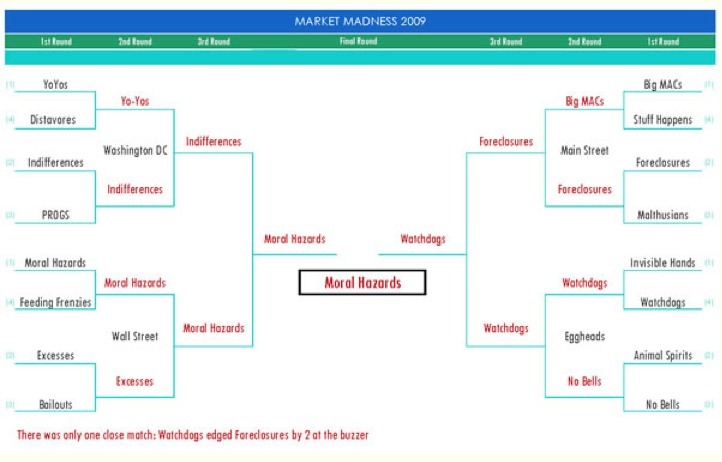
Chart of the Day – David Warsh at Economic Principals borrows a Market Madness chart from the University of Chicago’s Allen Sanderson to show where economists figure the economy went wrong.
Warsh explains:
Adopting as a metaphor the annual NCAA basketball tournament, he came up with sixteen competitive factors judged to have contributed to the global financial crisis and matched them up as in the graphic [above]. A few months later the American Economic Association printed the brackets in the program of its annual meeting and invited members to vote for their regional favorites and for a national champion.
For a description of the various teams, and a sense why voters concluded that the Hazards edged the Watchdogs in the tournament final, click [here]. The game may not yield much real information, but it’s a good exercise, a fine example of economists at play.
 Bali Arts