Abe’s 201st

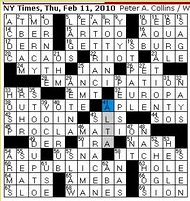
To celebrate the sixteenth president’s 201st birthday, the Times featured a Lincoln crossword puzzle yesterday.

Easier than most Thursday puzzles, this one was unique in my 50-plus years with NYT crosswords. For the first time I can remember, I got every one of the themed clues (Abe, Gettysburg, Emancipation Proclamation, Republican, and the top left corner to bottom right corner diagonal – Abraham Lincoln) before getting any of the crossing words. That sure made the rest of it fall into place quickly.

Rex Parker provides the completed puzzle above and further insights on his site.

Business strength for the iPad?

Apple watcher Jason Schwarz at TheStreet.com, after testing the iPad, believes Apple will sell 10 million of them in the first year.

Here’s why:

Nobody is talking about the iPad as a must-have business device but that is exactly what it is. Anyone who previously relied on a notepad or clipboard will adopt the iPad…. Think of all the real estate agents and other salesmen who operate at point of sale.

There’s more. And naturally Schwarz’s post drew skeptical comment. But now the iPad’s being tried outside of Apple’s labs, people find it has uses far beyond those the rumor mills were generating before folks got there hands on one.

Designers and artists – already a Mac constituency – will buy them to show their portfolios. Ad reps will use them with potential clients. If businesses discover it really is a productivity tool and start buying in bulk, 10 million in year one becomes almost conceivable.

Later update: Over at Seeking Alpha, where Schwarz posts regularly, his first comments on the iPad predicted sales of 5 million units in the first year. While Schwarz is long on Apple, and some people say he’s less credible for that, he seems more perceptive than most on exactly how the company still thinks different.
Colin Powell Changes His Tune

Classmate and friend Mo Hanan writes in the Huffington Post of his encounter with Colin Powell in Harvard Yard at our 25th reunion in 1993.

“Attitudes and circumstances have changed,” Powell said [last week]. “It’s been a whole generation” since the [don’t-ask-don’t-tell] legislation was adopted, and there is increased “acceptance of gays and lesbians in society,” he said. “Society is always reflected in the military. It’s where we get our soldiers from.”

Colin Powell Changes His Tune

Dept. of Corrections and Amplifications

With reference to this iPad post last week, a regular reader writes:

Actually, there was an iTunes before the iPod – iTunes came out January 2001, the first iPod was released October 2001. And I make this point not just to be a nitpicky bastard, but because I think it’s really important to understanding why the iPod succeeded.

iTunes allowed the iPod to offload complex functionality to software running somewhere else, whereas all its competitors needed UI for things like adding music to the device. It wasn’t just that their UI was worse, it was there was so much more of it.

And I should probably have noted that about 75 percent of those three billion app-downloading transactions involved zero money changing hands.

That said, I’m still hoping for a few armchairs at the Apple Store on W. 67th St. so customers can replicate the living room experience of just sitting comfortably with the device for a few minutes.

On giving to Haiti

On NPR’s Talk of the Nation today, Chronicle of Philanthropy editor Stacy Palmer made the key points about giving to Haitian relief charities: “The most important thing is to find out whether the charity has experience doing disaster work and working in Haiti… [T]hat’s the best way to guarantee that your dollars will go to the right thing.”

Stephanie Strom’s February 1 NYT story on pooling relief money to make it more effective began:

Before the earthquake, the American Red Cross had 15 people in Haiti working on projects like malaria prevention and measles vaccines. Partners in Health, a charity based in Boston, had more than 700 doctors and nurses among a staff of almost 5,000 operating a hospital and multiple clinics in the country.

Yet the Red Cross has raised nearly $200 million for its relief operations in Haiti, and Partners in Health about $40 million.

Disaster fund-raising rewards organizations for their marketing prowess and name recognition as much if not more than for the scope, relevance and quality of their emergency services.

Over at Economic Principals, David Warsh focuses his weekly column on Haiti’s uniquely dysfunctional history and culture and on the same organization, Partners in Health, which has been making a difference there for 23 years.

PIH is unusual among foreign-funded relief organizations in that almost all its employees in Haiti – including its leadership there – are Haitians. PIH’s Stand With Haiti campaign appears to be one place where Haiti donations are likely to be spent efficiently.