Bidding started at IDR 15 million at ARMA last Sunday for a 1973 painting of Kala Rahu.
The work, signed on the back by I Ketut Madra and on the front by his then-teen-age student Dewa Nyoman Pyadnya, shows Kala Rahu in the heavenly garden of the gods about to drink the elixir of immortality (tirta amerta). He is spotted by Ratih, goddess of the moon at upper right; she alerts Wisnu (just below), who prepares to hurl his spiked and razor-edged discus (cakra) at the intruder.
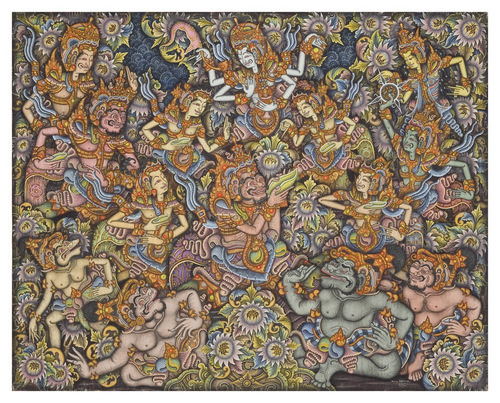
The work was selected by Larasati from about 20 pieces in the recent Museum Puri Lukisan exhibition, “Ketut Madra and 100 Years of Balinese Wayang Painting.” Larasati chose the painting in part because this scene from the Kala Rahu story is rarely shown in Balinese art and in part for the clarity of the representation of all the attending deities.
Ketut Madra had four apprentices in 1973. It was the traditional way for a young person to learn to paint. The student would live at the master’s house, help to prepare canvas and tools, and learn the ancient stories of the wayang kulit and the technique of capturing them on paper and canvas.
Dewa Nyoman was Madra’s most talented student that year by far. For a large work on canvas such as this, his assistance, under close supervision, would include adding shading to the line and then some of the color after the fully inked drawing of each element had been completed by Madra.
There were five bids for the work and the auction hammer fell at 19 million rupiah.
I still don’t know who bought the piece.
 Bali Arts