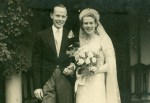
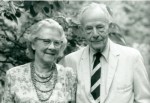
Audrey and Richard Irons on their wedding day and their 50th anniversary, July 28, 1988. Below, remarks by David Irons at the service of thanksgiving for the life of Audrey Irons at St. John’s Chapel at Groton School on June 26, 2010.
Our mother was a teacher, too.
She was also a traveler. And a willing expatriate. Who married for love – and knew how love worked.
In her time, she knew great joy and happiness. And gave from great kindness. And behind that warm, friendly, wise and knowing face there was also great courage – and more than a measure of stoicism.
For she also knew hardship: Her father died in her third year; her older sister, brain-damaged at birth, was institutionalized; her last years were far from easy.
—
Growing up in rural Wiltshire almost within sight of Stonehenge, she loved everything about the natural world. It was perhaps a kind of Beatrix-Potter-meets-“Wind-in-the-Willows” childhood. She certainly enjoyed reading those stories to children and grandchildren – Jemima Puddle Duck… Mrs. Tiggy Winkle… and ‘messing around in boats.’
She was also an explorer. In 1934, at 22, she traveled by steamship out through the Suez Canal to Kenya colony to be the maid of honor at the Nairobi wedding of her first cousin – and closest childhood friend – Helen Rabagliati.
Some three years later, visiting relatives and family friends in the U.S., she met our father in Wilmington, Delaware at a New Year’s Eve dance. With that twinkle in her eye that you all knew, she would, with prompting, recall that our father had already called her four times before she awoke on New Years Day.
By the time she returned to England in the spring of ’38, she was engaged. Though her mother gave her a two-seater sports car, probably with an eye to taking her mind off this American adventure, Audrey Radcliffe was not to be deterred. They were married in Salisbury Cathedral in July. She and my father toured the Lake Country on their honeymoon in that car, and then sold it before catching the ship from Southampton.
—
Openness to adventure was something she taught us early. We might be returning from the grocery store and she’d say: “Do you want to go exploring?” The answer was always, “Sure.” And we’d return home by a roundabout route that would take 20 to 30 minutes more than usual and almost always meant going down at least one road we’d never been down before.
I believe the 25-year-old bride who arrived at Groton School that fall found she had come home. There’s a lot of England in New England. Orchards, dairies and forests surrounded the school. Our father used to say that the view from their bedroom – about 250 yards that way – reminded them of an English country village with Brooks House resembling a tithe barn, the Gothic chapel beyond, and the bells ringing the quarter hour.
Audrey Irons became an essential part of the life of this school. By ‘essential’ I don’t mean ‘indispensible.’ She was one of the many faculty wives who made this school the community that it was. She reflected the best of its essence. And she mitigated the testosterone of an all-boys school in civilizing ways. She opened her heart and her home to the Groton commune, and people depended on her.
She probably knew some 2000 young Grotonians in the years our father taught here, and I expect she knew hundreds of those boys very well.
Two people here today wrote to tell me they confided in her as teenagers. They were wise to do so. And they were certainly not alone. For she knew how to listen and her advice was always sound and grounded in reality. And unless she thought you were about to make a mistake, it was almost always optimistic and encouraging.
Through her 55 years of volunteer work with the Red Cross she came quite literally to know thousands more people who lived in the surrounding towns of the Nashoba Valley. She didn’t know them all well, but they knew who she was, and that it was she who made the Red Cross bloodmobile run on time. And they all depended on her.
—
Over the past two months I’ve found myself remembering her words and her way of saying them.
Just one example: I’d finished Harvard and army service and had no idea at all what I wanted to do for a career. My father was quietly urging me toward banking, and I was resisting that. Suddenly, I had an invitation to help deliver a big racing sailboat from Hawaii to Australia for the Sydney-Hobart Race.
The scene is the living room of the Groton School house in the early spring of 1971. I’m telling my parents about this great opportunity. Dad is skeptical. Mom looks at him with a smile and says: “Well, Dick, it seems what David’s proposing is to live out the fantasy of every 55-year-old man at an age when he can enjoy it.” Dad burst out laughing– and my adventures in the South Pacific, Australia and Indonesia lasted for two-and-a-half years and probably did as much to make me the adult I am today as anything I’ve ever done.
—
In 1972, Mom and Dad moved to the house on Main Street that they’d chosen for their retirement. Those were good and happy years in the home that all her grandchildren came to love as Farmor and Farfar’s place. They transformed that property into a quiet oasis where family chose to gather. They rarely spent a holiday alone.
It was a place all the grandchildren had in common: great breakfasts, library visits, helping in the garden, ping pong, croquet, bagatelle – and even history and tennis lessons.
Not too many years after Dad died in 1993, Mom realized that maintaining that rambling old five-level house was more than she could manage on her own.
She eventually decided on the Edgewood community in North Andover – and looked forward to moving to her apartment there with the assurance of assisted living when she needed it.
A never completely understood combination of stress, possible small strokes and infection created a health crisis just as she moved there. It undermined her physical strength and caused her to lose her short-term memory. And meant she needed assistance much more quickly than any of us had expected.
Fortunately, Clifford lived nearby, and for the past decade has been there to manage her care and visit her every week – and much, much more.
Mom’s loss of short-term memory meant that Edgewood never became the new community that she had imagined. It is difficult to make new friends when one cannot remember names or what one heard or said the day before.
One way she dealt with that was by turning to favorite books. These novels were old friends and she could start her conversation with them on almost any page – whether reading on her own, or being read to.
Despite her infirmities – her inability to initiate phone calls or write letters – she never lost her essence: that strong sense of self combined with quiet curiosity and that great kindness. Her caregivers at her Edgewood apartment came to realize that if engaged, she could and would offer them useful advice on dealing with the problems of their lives.
Over the last two years as her frailty increased, she somehow managed to overcome much of her short-term memory loss. In 2008, we were able to have phone conversations about pages in Obama’s “Dreams From My Father” that she had read days before. Conversations with her reminded us again of the steadfast “Farmor” of her Groton retirement days.
—
A week before she died, my mother was talking in her sleep. I was writing on my laptop in her room and just started taking down what she was saying. There were long pauses between some of the sentences, but it was all coherent and clear.
This is what she said:
“I don’t know who makes the rules but somebody does because they are there.
"There are so many paths in this world that are interesting to me, so I take them. I’ve walked many, many miles without knowing where the road is going. But the road must be going somewhere, so I take it.
“And I’ve enjoyed the roads I’ve taken. Some more than others.
“The world is a very beautiful place and I’ve always enjoyed being in it.
"I was taught to be good to people and to treat everyone well. I learned that at a very young age. I was also told I could take it or leave it. I took it.
“One has to believe in something and I was taught to believe in Jesus Christ.
“But it’s okay just to believe there is some kind of being in the sky. You don’t need to know exactly what kind, but you have to believe in something.
“If you don’t believe in something, what is there?
"I only speak English; you probably don’t, but it’s the only language I speak. Ah, well, you probably don’t understand.
"He ministers. He tries to teach his people. His plan. Some people will call themselves Christians…. after Jesus Christ. If you know who he is. The powerful Holy Bible tells Christians who they are… or tries to. It’s really a beautiful book. A very fine book about what Christians believe. Full of very good and holy thoughts.
"That’s what we call religion. You probably believe in something, don’t you? Some kind of God?
“Well, you don’t deny it, so you must believe in something. Or other. Whatever that other may be….
“Well, so do I.”



 Bali Arts