The Apostate – Paul Haggis vs. the Church of Scientology

A great New Yorker writer tackles a great subject.

And a Google search of “Lawrence Wright” Scientology measures the gathering storm that will greet the publication of his book. 

This story has been a long time coming, and it needed a tough-minded journalist who has delved deeply into the belief systems of the Amish, the Mormons, the Southern Baptists and the Islamists in the past.

The Apostate – Paul Haggis vs. the Church of Scientology

Alive In Egypt

The Alive In Egypt site has all the Dream TV interviews with Google’s Wael Ghonim. They are in Arabic with English subtitles. The interviews are in several segments, mostly about 12 minutes long, and may require a bit of digging to find as the site is changing rapidly and the interview is now two days old.

While Dream TV is a private Egyptian cable channel, like most non-governmental broadcasters in Egypt, it has rarely confronted the government in the past.

There’s also a much shorter video clip on The Guardian showing Wael Ghonim’s appearance before the crowds in Midan Tahrir today.

Alive In Egypt

Office of AUC Press in Tahrir Square Trashed by Egyptian Police

Inside Higher Ed’s Scott Jaschik reports on the ransacking of the AUC Press by Egyptian police on their way to the roof overlooking the southeastern corner of Tahrir Square.

AUC Press Director Mark Lynch takes the opportunity to highlight recently (and about-to-be) published work examining contemporary social and political issues in Egypt.

Office of AUC Press in Tahrir Square Trashed by Egyptian Police

The Daily… Hmm….

Okay, I’m trying The Daily on the iPad free for two weeks.

Never thought I’d subscribe to a Murdoch publication. Probably won’t. But it’s intriguing to see what a daily designed for the platform can do.

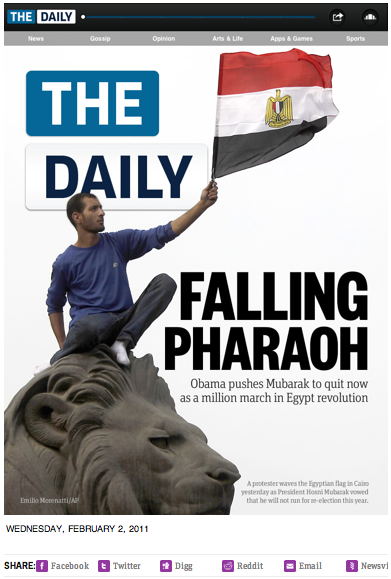
It’s a graphically flashy tabloid with content that’s derivative &/or trivial. Pages and pages of gossip and sports… but a nice inaugural cover with an Egyptian democrat astride one of the lions of the Kasr Al Nil Bridge.

The Daily’s own Web site doesn’t show all its content. But this New York Times Bits Blog points to an independent tumblr site that does. Wonder how long that will last.

It also seems a bit buggy in that it often needs to be started two or three times before it runs.

Egypt: Who to follow…

My two years with the American University in Cairo gave me a lasting interest in the downfall of Hosni Mubarak – and access to sources that I trust on the possibility of that almost impossible dream coming true.

For the most “Informed Comment” on events in Egypt and across the Middle East from American academe (left branch) there is the inestimable Juan Cole at the University of Michigan.

With a somewhat more middle-of-the-road perspective, now blogging at Foreign Policy, there is the ever-reliable Marc Lynch of GWU, aka Abu Aardvark.

For a real-time look at what people are saying in Tahrir Square right now, Egyptian feminist democrat, blogger and columnist Mona Eltahawy is tweeting and retweeting the revolution in her Twitter stream, now being followed by 15,000+ people around the world. Her take on what’s happening now is perhaps best summarized in this YouTube appearance on Democracy Now.  

Larry Pintak has a particularly well-timed new book, The New Arab Journalist, appearing this month. It’s based on 20-plus years of journalism experience in the Mideast and includes some path-breaking research from his years running AUC’s Center for Journalism and New Media. There a small sample of it here in a recent CNN column.

Former US ambassador to Egypt Frank Wisner is now in Cairo. I believe the reason President Obama and Secretary Clinton chose him is that they knew he would be able to get in to see Mubarak personally, and that they gave him precise and tough instruction to tell him to wind things up or risk losing it all in a violent end.

Finally, Nate Silver at The New York Times has tracked a remarkable recent shift in Egyptian public opinion on the US. There is real opportunity in these numbers for the Obama administration and U.S. policy in Egypt and the Middle East. 
Obama’s Compromise

While sharing some liberal discomfort over the President’s willingness to accommodate Republican insistence on maintaining the Bush tax cuts for the wealthiest, I’m thinking he really needs to focus on independent voters now and over the next two years. And he did that. After watching yesterday’s press conference, my respect for Obama’s focus on the middle class, the working poor, and the unemployed only grew, as did my appreciation of his vision of the battles to come. I still admire his strategic approach.

The “Irons in Bali” blog continues…

Somewhat to my surprise, a month after our return, I’m still posting to our Bali travel blog. And probably will be for a while yet.

While the focus of the trip was the celebration of daughter Edie’s 30th birthday (which actually took place yesterday), I also went there thinking that I should follow up with old Balinese friends on what to do next with my collection of Balinese paintings and antique kris collected in 1973.

Those conversations proved fruitful. I’m now planning an exhibition of Ketut Madra paintings at the ARMA Museum for next summer. More on Madra herehere, and here.

The changes in the Indonesian economy over the last 15 to 20 years, especially the growth of both middle- and upper-class wealth, have created a vibrant market there for the artwork I bought almost 40 years ago. It didn’t hurt that UNESCO recently declared wayang and kris as essential pieces of Indonesian world heritage. 

So, it looks like I’ll be going back twice next year and the Bali travel blog stays active. And it feels good that the Irons collection appears to be headed that way, too.