Sometimes, the system works.

David Wessel, economics editor at the Wall Street Journal, reports on an experiment in the stimulus package that is changing the marketplace for municipal bonds in ways that allow cities and towns, investors and the federal government to benefit.

Infrastructure investment usually only gets attention when roads and bridges and economies fail. The collapse of the bond market for cities and states prompted the administration to include a provision in the stimulus bill that shifted the marketplace for tax-free muni bonds. The former system cost the federal governent “more than $1 in forgone tax revenue to give $1 of help to state and local governments,” according to Wessel. The new direct federal subsidies with higher interest rates on the bonds opens the marketplace to new buyers, and everyone seems to agree the system is “better, cheaper and fairer,” he writes.

Today, beneath partisan gunfire and ideological clashes in Washington, one of the few things on which Democrats and Republicans in the Senate agree is that Build America Bonds should be made permanent. The program probably will be.

“Sometimes, the system works,” he concludes.

Some rare good news from Califonia

The San Francisco Chronicle reports today on a $16 million gift to UC Berkeley from the Evelyn and Walter Haas, Jr. Fund.

The gift will fund five new endowed chairs and a variety of research and public service programs designed to enhance Cal’s historical commitment of openness to all. Haas Jr. Fund President Ira Hirschfield has posted a deeply thoughtful open letter that explains the motivation for and history behind the gift.

Hirschfield’s letter refers to Cal’s admissions process several times and he says the gift also “includes a challenge grant for endowed scholarships for low-income students….”

Oddly the Chronicle story includes these two seemingly contradictory paragraphs:

Although the newly announced program does not address student admissions, [Berkeley Chancellor] Birgenau said, it is designed to make UC Berkeley’s environment “more inclusive” and therefore make the university “progressively more attractive to people from diverse backgrounds.”

The funding also includes $1.5 million for scholarships for transferring community college students.’

Scholarships for low-income, community college students (largely overlapping sets) certainly have a huge impact on their ability to attend if admitted.

When I worked at Berkeley’s Haas School of Business (1985-1997), about half the students in the undergraduate business program were community college transfers. As I recall, juniors entering the program from Berkeley had to have a GPA of 3.6 or higher – and most of those coming from the junior colleges had 4.0’s. A brighter, harder working, more motivated group of students would be hard to find anywhere.

The ongoing dysfunction of California’s budget and politics has hit public higher education hard at every level. Tuition and fee increases have made it impossible for many qualified students to attend community colleges, state universities and UC System schools. It’s good to see private institutions working to maintain the promise of Clark Kerr’s inspirational master plan to make public higher ed in California affordable to all.

Total support for the initiative will rise to some $31 million with matching funds. The Hewlett Foundation is also on board.

Late update: UC Berkeley’s news release is here.

Paul Volcker on the “crisis in governance”

Politico reports on Fareed Zakaria’s CNN Global GPS interview with Paul Volcker and his concern about the “crisis in governance.”

Volcker: “Capitol Hill – the Senate – is dysfunctional…. We are more than a year after the inauguration and neither the undersecretary for international [affairs] or the undersecretary for domestic finance – you don’t have them. It’s not because people haven’t been put forward. It took them a long time to get them nominated and an impossible amount of time to get them confirmed…. How can the Treasury effectively function … without the top officials in place that are needed?

Nora Ephron selects romantic comedies

“From a surprise Hitchcock flick to a classic Audrey Hepburn and Cary Grant pairing, the queen of romantic comedies picks her top eleven favorites for Valentine’s Day” – #10 on the list is Casablanca, playing this evening at the Bay Street Theatre in Sag Harbor.

We’ll be there.

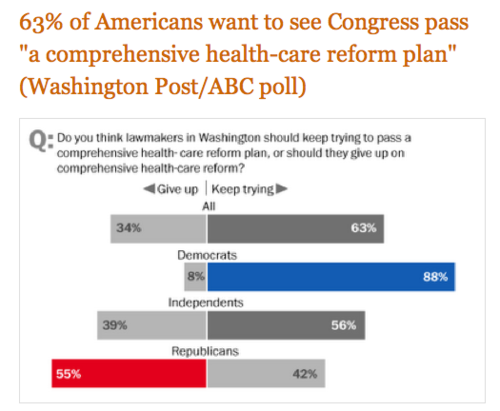
The polling and politics of health insurance reform

Chart of the Day

Via Jeff Weintraub, why moving forward on health insurance reform looks like a political winner for the President.

And over at the New England Journal of Medicine, Brookings scholar Henry Aaron makes a compelling case for the reconciliation route. His conclusion:

Reformers’ best choice is to embrace the democratic process and attempt to persuade voters that the current legislation is in the national interest. They have 10 months to succeed before the midterm elections. If would-be reformers retreat in the face of current public opinion polls, they will be sent packing in November. Arguably, they will deserve to lose. If they stand up for their genuinely constructive legislation, they can prevail — and will deserve to win.


The economics and politics of snow removal

Steve Pearlstein is one reason to keep reading the Washington Post. His Feb. 10 column – “Snow-blind: What Washington’s winter storm says about broken politics” – is superb.

There is no earthly reason why the Washington metro area cannot and should not be able to clean up after a snowstorm. The economic losses are huge and measurable. The investment required to fix the problem is manageable, but the political will to tax is nonexistent.